The quantum technology already riding on robots is a sensor, not a processor
Magnetometers and atom interferometers are the part of the stack where quantum effects and embodied machines genuinely meet — and it has nothing to do with computation.
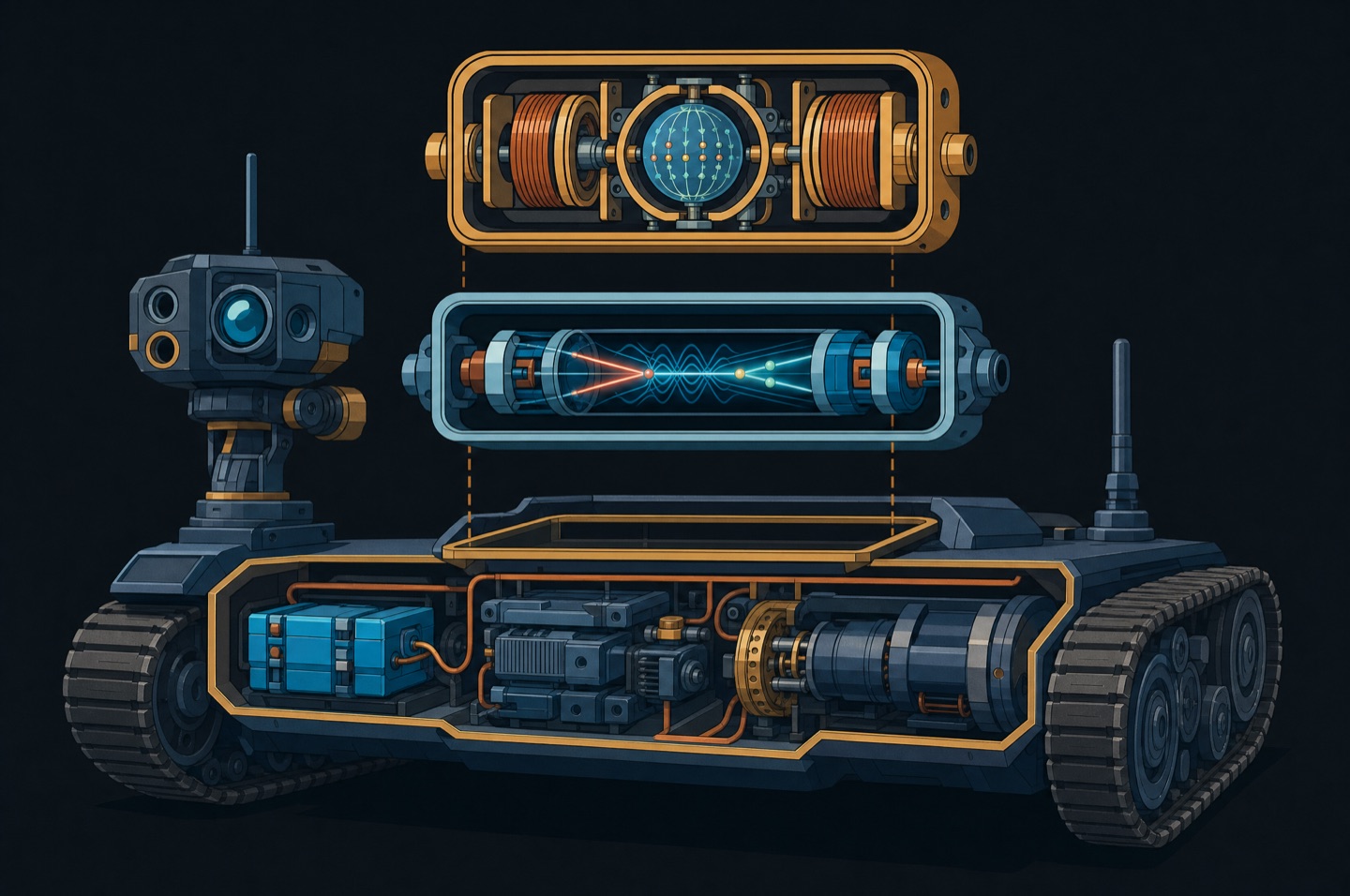
The intersection everyone writes about is quantum computing and AI. The intersection that actually has hardware in the field is quantum sensing and robotics, and it is a quieter story because it does not involve a model of any kind.
The mechanism is that quantum systems make exquisitely sensitive transducers. Nitrogen-vacancy centres in diamond respond to magnetic fields at room temperature and at small scale. Optically pumped magnetometers reach sensitivities that were once the exclusive territory of cryogenic SQUIDs. Atom interferometers measure acceleration and rotation by treating atoms as waves and reading the interference. None of these compute anything. They measure, extremely well.
For an embodied machine the payoff is navigation without satellites. Inertial navigation drifts, and the drift is what forces a GPS fix; a sufficiently low-drift quantum inertial sensor extends how long a vehicle can dead-reckon underwater, underground, indoors or under jamming. Magnetic anomaly maps offer a second, independent positioning channel that cannot be spoofed the way a radio signal can. Gravimetry from a moving platform maps what is under the surface without digging.
The engineering constraints are the ordinary ones — size, weight, power, vibration, cost, and how gracefully the device degrades when it is bolted to something that moves. Those are the numbers to interrogate in any claim, and they are more informative than the sensitivity figure quoted in isolation. But the category is real, it is not speculative in the way quantum machine learning is, and it deserves more of the attention that currently flows to the processor story.