A quantum computer will never sit inside a robot’s control loop
Not because the hardware is immature — because the latency budget of balance is three orders of magnitude smaller than the round trip to a dilution refrigerator.
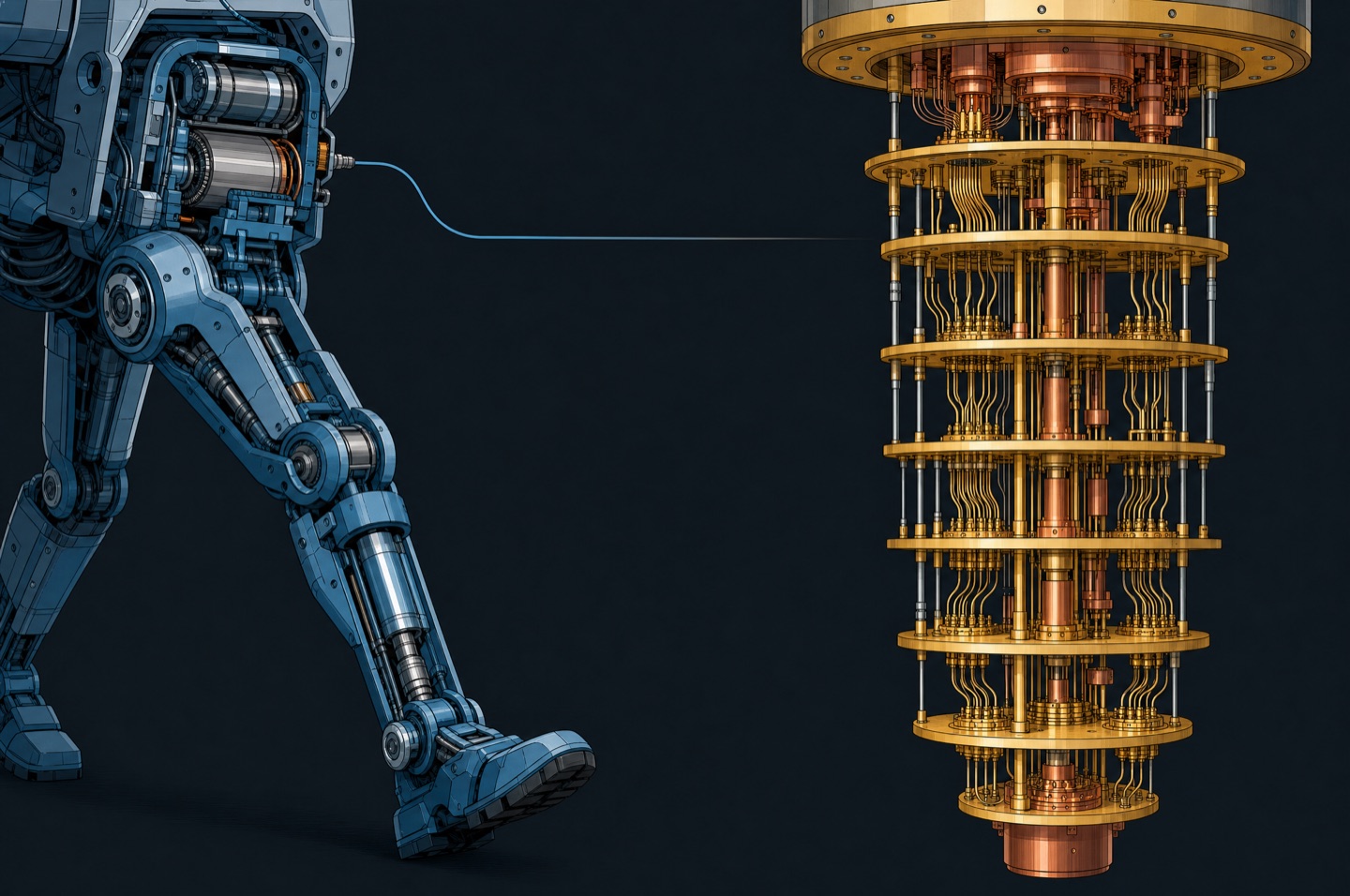
A legged robot closes its balance loop somewhere between 500Hz and 2kHz. That gives the whole sense-decide-actuate path something on the order of a millisecond, and most of it is already spoken for by sensor read, state estimation and motor commutation. Whatever else happens in that window, it happens on a processor bolted to the machine.
Now price the alternative. A superconducting quantum processor lives at roughly 10 millikelvin inside a dilution refrigerator that is not going anywhere. Reaching it means leaving the robot, crossing a network, queueing behind other jobs, compiling a circuit to the device’s native gate set, running many shots to beat down sampling noise, and returning a distribution that still has to be classically post-processed. The honest unit for that round trip is seconds. Even in the most favourable framing — a co-located machine, a warm queue, a shallow circuit — the gap to a millisecond is not an engineering increment.
This is worth stating plainly because the alternative framing keeps reappearing: that quantum hardware will eventually get fast enough to participate in real-time control. It will not, and the reason is structural rather than temporal. The refrigerator is not a temporary inconvenience on the way to a room-temperature part. Trapped-ion and neutral-atom platforms relax the cryogenics but pay for it in gate times measured in microseconds to milliseconds, which puts the circuit itself inside the control budget before any communication overhead.
The useful conclusion is not that quantum computing is irrelevant to robotics. It is that the interface between them is offline and by design. Anything quantum contributes to an embodied system arrives before deployment — in a material that was simulated, a policy that was pre-computed, a schedule that was solved overnight — and is compiled into weights, tables and parts that the robot carries with it. Design the interface that way and the two fields have plenty to say to each other. Design it as a coprocessor call from a control loop and the architecture is wrong on the first line.