Scaling a quantum computer is mostly a wiring problem
Every qubit needs control lines, and every control line carries heat into a fridge with a strictly finite cooling budget.
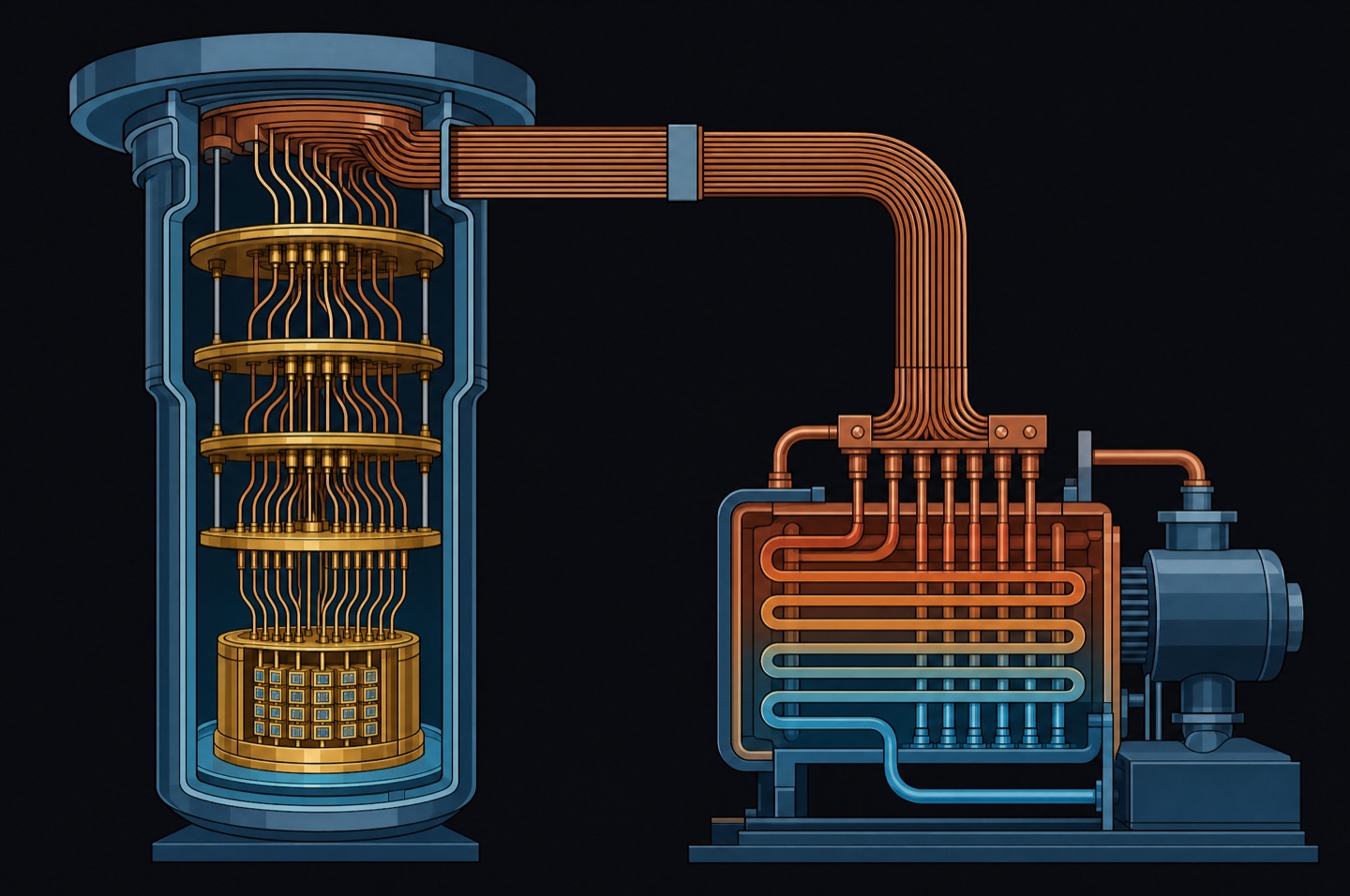
The physics gets the attention; the obstruction is thermal and mechanical. Each qubit needs control and readout lines running from room-temperature electronics down through the stages of a dilution refrigerator. Each line conducts heat. The cooling power available at the coldest stage is small and does not scale with ambition.
Multiply by thousands and the problem stops being about coherence and starts being about cable count, connector density, physical volume and heat load. There is a limit to how many coaxial lines fit through the plumbing of a fridge, and it arrives well before the qubit counts that fault-tolerant estimates call for.
Cryogenic control electronics is the response: move the control circuitry into the cold, so that many qubits are driven by a local chip rather than by an individual line to the outside world. The difficulty is that this circuitry dissipates power exactly where power is most expensive, which turns the design into a negotiation between control fidelity and heat budget.
This is unglamorous systems engineering and it is where a great deal of the real scaling work sits. It is also a useful lens for reading roadmaps: a plan that describes qubit counts without describing how the lines and the heat scale has skipped the part that binds.